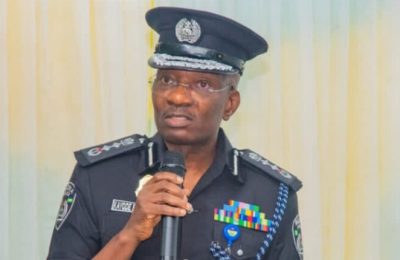
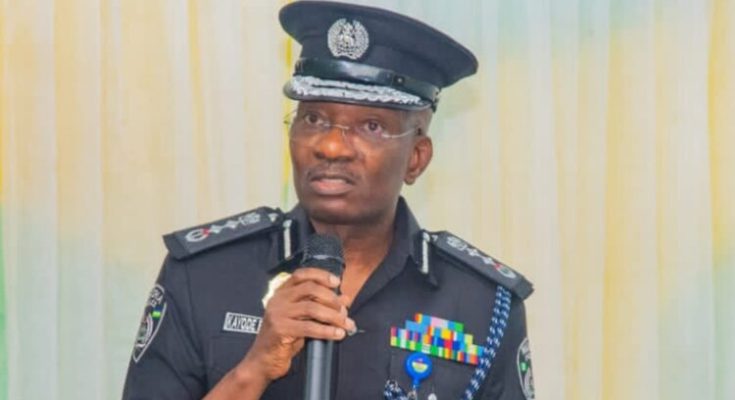

Former Inspector-General of Police, Kayode Egbetokun, was removed from office by President Bola Tinubu over his reported resistance to the President’s directive to withdraw police officers from Very Important Personalities protection duties, Saturday PUNCH has learnt.
According to multiple highly placed officials in the Presidency and the police establishment with first-hand knowledge of events that unfolded between Monday evening and Tuesday, the former IG was also compelled to resign over his alleged opposition to state policing and vindictive conducts towards colleagues.
Although Egbetokun officially cited “family issues” in his resignation letter submitted on Tuesday, insiders told our correspondent that the former police chief was summoned to the Presidential Villa and informed that he had to step down.
The sources spoke on condition of anonymity because they were not authorised to comment on the matter.
“That Monday evening, he (the President) called him to tell him that he has to go,” one of the sources said.
Another insider explained that the former IG pleaded for more time, asking to be allowed to complete his four-year tenure, which was expected to run until October 2027 under a 2024 amendment to the Police Act granting IGs a fixed term regardless of age or years of service.
“The former IG was supposed to go in 2027. He begged that he be allowed to complete his term. The President said no, he had to go,” the source said.
Saturday PUNCH gathered that the President’s decision was driven by three grievances that had accumulated over several months.
The most immediate trigger, Presidency sources said, was Egbetokun’s handling of the November 23, 2025 presidential directive ordering the withdrawal of over 11,000 police officers from VIP protection duties for them to be redeployed to communities plagued by kidnapping, banditry and terrorism.
An official in the Presidency told our correspondent that Egbetokun did not merely drag his feet but pushed back directly against the President during a meeting with security chiefs, arguing that business leaders and senior corporate executives needed police protection.
“One of the issues is the withdrawal of police from VIPs. He didn’t execute it as quickly as the President wanted. He did it halfheartedly. He actually argued against it with the President during the security meeting, saying that the economic actors, the business people need to be protected,” he said.
The source added that the President rejected the argument, pointing to the Nigeria Security and Civil Defence Corps as an adequate replacement.
“The President said yes, they need to be protected. But the police don’t have to protect them. Civil Defence can protect them. In fact, he said, ‘the Civil Defence is even more lethal in handling of arms. So, what are you talking about? What is the difference between Civil Defence and the police? They are both carrying arms. So why are you fixated on having police to do that?’
“We are not saying they won’t be protected because they are the bloodstream of the economy. We don’t want our business people to die the kind of death they shouldn’t die. But Civil Defence are trained. They’re even more lethal than police. In any case, the business people also have the resources to hire their own security,” the source added.
On December 10, 2025, weeks after issuing the initial order, President Tinubu reiterated the order at a Federal Executive Council meeting, declaring it “non-negotiable” and directing the Minister of Interior, Olubunmi Tunji-Ojo, to work with the IGP and NSCDC to replace the withdrawn officers.
He also asked the National Security Adviser, Nuhu Ribadu, and the Department of State Services to issue further guidance and ensure the directive is effected.
Another insider knowledgeable about the incident revealed that the initial resistance had a financial dimension.
According to the source, the VIP deployment scheme generated over N300bn annually for the police through a system in which businesses and individuals pay a fee for each officer deployed to them.
“The truth of the matter is, from what we know, what goes into police from money that these people pay for protection is over N300bn annually.
“They collect N100,000 per month from one officer. So, they will give the officer maybe N50,000. So, the rest goes through the chain. It trickles down.
“The President’s order was very disruptive. So, the police establishment was not happy because he removed a big income source from them. They resisted it. Some of them started wearing mufti. So, it means that they found a way to compromise it and the President got to learn about it,” the source said.
Reports had earlier indicated that some officers, rather than comply with the withdrawal order, disguised themselves in NSCDC and vigilante uniforms to continue protecting VIPs, while others paid as much as N500,000 to have their service rifles reissued after returning them.
State police opposition
The second grievance, according to multiple sources who spoke with Saturday PUNCH, is Egbetokun’s alleged opposition to the creation of state police.
State police creation is a flagship security reform that President Tinubu has championed and it is currently the subject of a constitutional amendment process in the National Assembly.
A source familiar with the President’s thinking said the former IGP went as far as presenting a memorandum against state policing at a National Assembly public hearing, a move seen as a direct challenge to the administration’s policy direction.
“He is publicly against state police. Even at the National Assembly, the police memorandum that he read when they did public hearing, he was against it.
“How can you be against something that your Commander-In-Chief wants? He attended a public event where you are arguing against state police. It wasn’t a prudent thing to be openly against what your principal is pushing,” the source said.
He cited the timing of Egbetokun’s exit, saying, “Just hours after the former IGP was summoned to the Villa on Monday evening, President Tinubu had told state governors at an interfaith breaking of fast that the establishment of state police would not be postponed.
“Without it, farms cannot flourish, businesses cannot grow, and families cannot sleep in peace. We will establish state police to curb insecurity,” the President declared at the dinner.
During another Iftar dinner on Wednesday, Tinubu requested the National Assembly to begin the process of amending the constitution to incorporate state police as part of efforts to tackle the nation’s security challenges.
Vindictive conduct
The third reason, sources said, related to Egbetokun’s conduct toward colleagues, particularly his treatment of Olatunji Disu, the man who ultimately replaced him as the Acting Inspector General of Police.
Both men served under Tinubu when he was governor of Lagos State between 1999 and 2007.
Egbetokun was the Chief Security Officer while Disu as Aide-De-Camp, and both owed their career advancement to the President’s political support.
A Presidency source who spoke on condition of anonymity said the President found Egbetokun’s behaviour toward those who had shared the same journey troubling.
“The President doesn’t like people using power against their peers, your friends, people that you grew up with, people that were with you, your colleagues, those who were part of your career growth.
“He (Egbetokun) used his position against Disu. They both served Tinubu when he was governor. Disu was ADC, he was CSO.
“How can somebody that two of you were mentored by the same person and has been instrumental to lifting all of you…So, if Tinubu acted like him, would he have gotten here?” the source said.
He added that the President had been instrumental to every major promotion Egbetokun received throughout his police career, including during the administration of former President Muhammadu Buhari.
The insider said, “Tinubu helped him to attain all the positions he got to. It was Tinubu that was pushing him, using political leverage. Tinubu was the one that pushed him to commissioner of police, to be DIG and he eventually became the IG.
“He got Buhari to promote him four times. I mean, he wrote formal letters to Buhari for all his promotions. So, if you have enjoyed someone’s favour, why do you use your position against other people?”
He added that Egbetokun had been hoping Disu would quietly retire from service upon turning 60 in April 2026, removing him as a rival without any overt action.
“He also wanted him to retire out of service in April. He was hoping that this guy is going to retire. So, he just wanted him to ease out by age. But you know the good thing is, the President signed that act that once you become IG, that four-year kicks in,” the source said.
Police Council to meet next week
However, a source familiar with the transition process told our correspondent that the Nigeria Police Council is expected to meet next week to formally consider Disu’s confirmation.
“The Police Council meeting is going to be next week. I’m hearing Monday. But until the schedule is set and invitations have been sent out, it can change,” he said.
Disu currently serves in an acting capacity. The Police Council is expected to consider his appointment after which President Tinubu will transmit his name to the Senate for confirmation as substantive IGP, in line with the Police Act 2020.
Tinubu appointed Egbetokun as the 22nd IGP on June 19, 2023, shortly after his inauguration.
Egbetokun succeeded Alkali Baba, whose tenure had expired in September 2023 following an extension granted by former President Buhari.
The appointment drew early criticism because Egbetokun, born on September 4, 1964, was approaching the mandatory retirement age of 60.
When he turned 60 in September 2024, civil society groups called for his retirement, but the National Assembly passed the Police Act (Amendment) Bill in July 2024, granting IGPs a fixed four-year tenure regardless of age, effectively extending his stay until October 2027.
His replacement, Disu, 59, a Lagos Island native, joined the police on May 18, 1992. He holds a bachelor’s degree in English Education from Lagos State University and master’s degrees in Public Administration and in Criminology, Security and Legal Psychology.