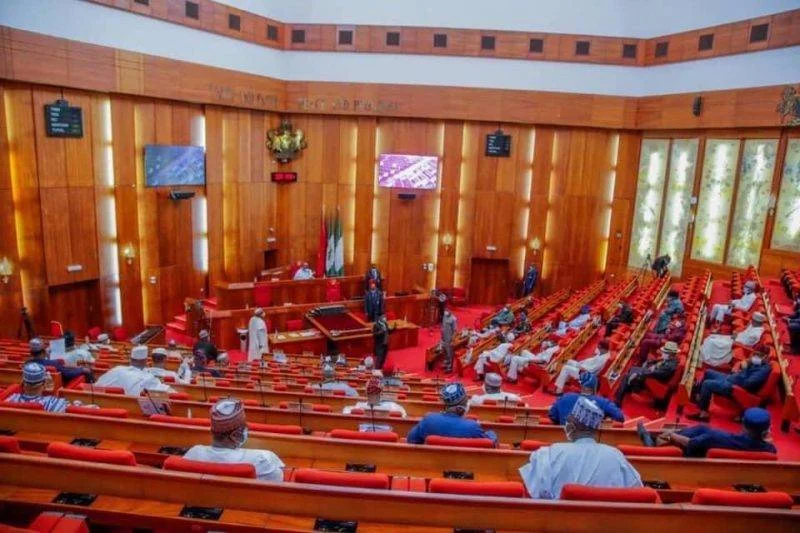
The Senate on Wednesday passed the landmark Constitution Alteration Bill seeking to establish state police across the federation, marking a major step in Nigeria’s decades-long debate over decentralising the country’s policing structure to address worsening insecurity.
The passage followed a rigorous clause-by-clause consideration of the bill and came after more than two-thirds of senators voted in support through a manual voting process conducted on the floor of the chamber.
Senate President, Godswill Akpabio, announced the passage of the legislation after lawmakers overwhelmingly backed the proposal during plenary.
The upper chamber approved the bill after considering the report of the Senate Committee on the Review of the Constitution, presented by Deputy Senate President and committee chairman, Barau Jibrin.
The bill’s provisions were first considered at the Committee of the Whole before lawmakers adopted them and proceeded to a final vote.
Debate on the legislation was led by Senate Leader, Opeyemi Bamidele, who urged senators to support what many lawmakers described as a critical reform aimed at strengthening internal security and improving response to local threats.
The legislation seeks to establish a state policing framework that would operate concurrently with the existing federal police system, effectively ending the exclusive control of policing by the Federal Government.
A key provision of the bill “empowers state governors to appoint Commissioners of Police for their respective states, subject to confirmation by the state Houses of Assembly.”
Under Clause 17 of the proposed constitutional amendment, “while the Federal Police Service will continue to be headed by the Inspector-General of Police, each State Police Service shall be headed by a Commissioner of Police appointed by the governor and confirmed by the legislature of the state.”
The bill further outlines the operational relationship between governors and state police commands.
Section 17(6) provides that “a governor may issue lawful written directives of a general policy nature to the Commissioner of Police on matters relating to the maintenance of public safety and public order within the state.”
To address concerns over potential abuse of the new policing structure by state governments, lawmakers included safeguards aimed at protecting political freedoms and civil liberties.
Section 17(7) specifically states that “a state Commissioner of Police shall not arrest, detain, investigate or deploy force against any person, political party or group merely for criticising the government except in accordance with the law.”
The provision is intended to prevent state police formations from being weaponised against political opponents, activists, journalists or dissenting voices and ensures that any action taken must comply with due process and existing legal provisions.
The passage of the bill came barely an hour after the Senate abandoned plans to deploy an electronic voting system for the consideration of the State Police Bill and other constitutional amendment proposals.
Lawmakers instead adopted a manual voting process following concerns that technical glitches affecting some voting devices could disenfranchise senators and undermine the integrity of the exercise.
The decision followed a motion made by Bamidele, who argued that every senator should be given an equal opportunity to participate in the historic vote.
Akpabio backed the proposal, insisting that an open voting system would not only guarantee full participation but also promote transparency by allowing Nigerians to know where their representatives stood on critical constitutional issues.
Several senior government officials, including the Governor of Kaduna State, Senator Uba Sani; Governor of Ogun State, Prince Dapo Abiodun; Governor of Ondo State, Lucky Aiyedatiwa; and the Chief of Staff to President Bola Tinubu, Femi Gbajabiamila, witnessed the Senate’s decision on the floor of the Senate.
Following the adoption of the motion, senators were called individually to publicly declare their votes during the consideration of the constitutional amendment bills.
The successful passage of the State Police Bill represents one of the most consequential constitutional reforms undertaken by the 10th National Assembly and is expected to reshape Nigeria’s security architecture if it secures the required approval of state Houses of Assembly and other constitutional processes.
Credit: Punch